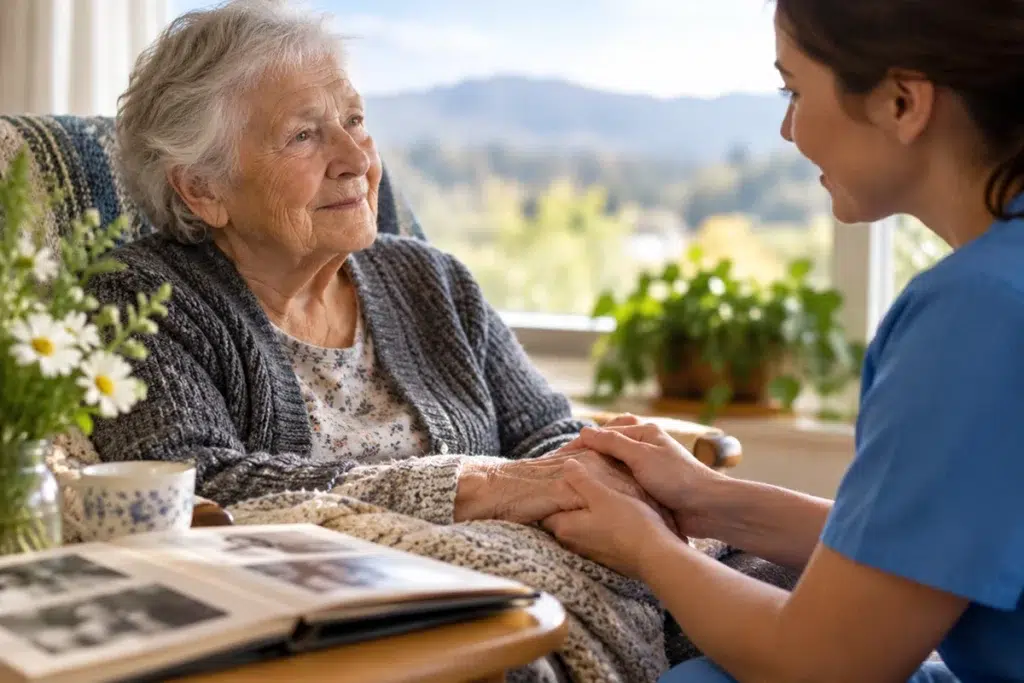

Across Canada, more people are receiving palliative care than ever before. The Canadian Institute for Health Information reports that 58% of Canadians who died in 2021 to 2022 had some access to palliative care. This is up from 52% five years earlier, showing real, measurable progress1. And yet an estimated 2.8 million Canadians living with a serious illness might still benefit from a palliative approach they aren’t yet receiving, and access continues to depend heavily on where a person lives, their age, and their diagnosis2. Progress and gaps, side by side. That’s the honest state of palliative care in Canada right now.
Behind the statistics is a workforce of interprofessionals often including PSWs, nurses, physicians, home support workers, hospice volunteers, and family caregivers, all trying to hold quality care together, with limited time, limited resources, and little formal preparation for the emotional weight of the work. If we want the next five years of progress to outpace the last, closing the workforce’s training and support gap must be part of the plan, caring for the wellbeing of the people doing that training and delivering that care.
This post looks at both sides of that equation: what the research tells us about sustaining the people who provide palliative care, and how structured, ongoing palliative care training and education is one of the most practical tools we have for building a genuinely resilient, whole-person palliative approach across Canadian care settings from long-term care and home support to hospitals and hospice.
The Weight Carried by Canada’s Palliative Care Workforce
Palliative care work asks a lot of the people who provide it: bearing witness to suffering, holding space for families, supporting grief while still showing up for the next person on their list, often within systems that are stretched thin. Research consistently shows that the psychological and emotional wellbeing of palliative care professionals has historically been treated as an individual responsibility rather than a systemic or organizational one. This approach is increasingly recognized as inadequate, because it ignores the ethical and structural dimensions of caregiver suffering3.
According to a 2025 study, the accumulation of end-of-life care stress is one of the strongest predictors of poorer mental health among palliative care professionals and the same research identified self-compassion and psychological flexibility as key protective factors4. That finding enormously influences how we think about training, for if self-compassion and psychological flexibility protect mental health, then teaching those capacities deliberately and not just hoping people develop them on their own becomes part of good workforce design, not an extra.
A 2025 scoping review of resilience-building among palliative care professionals specifically supports this. It identified five essential elements that consistently show up in effective programs: regularity, self-care, mindfulness, reflective practice, and cognitive-behavioural strategies, alongside three supporting, organisational elements: peer support, educational sessions, and organisational backing5. Many of which are, in essence, forms of education and structured reflection. Training and wellbeing aren’t separate conversations. Done well, they’re the same conversation.
Existential and spiritual strengths matter here too. Recent literature on existential and spiritual dimensions of palliative care found that meaning-making for patients and for the teams caring for them is a significant, evidence-supported contributor to resilience and quality of care, not a “soft” add-on to clinical competence6. Psychological safety and team functioning research points the same way: teams where members feel safe to speak up, debrief, and ask for support deliver more consistent, higher-quality care, and retain staff longer7.
Emotional Labour Is Clinical Skill and It Can Be Taught
Looking at research on the emotional labour of end-of-life care concludes what many PSWs, nurses, and home support workers already know from experience: bearing witness to dying, holding families through the worst days of their lives, and managing one’s own grief while remaining present for someone else’s is not incidental to the job8. It is skilled, relational, clinical work and research on the “invisible workforce” of personal support workers specifically highlights how much of this emotional and relational labour goes unrecognized, undercompensated, and, critically, under-taught9.
If we consider emotional labour as a skill, it belongs in the curriculum, not just in on-the-job trial and error. Research into the training needs of direct care providers in palliative settings has consistently found that PSWs, HCAs, and other direct care staff want and need more structured preparation not just for symptom management and physical care, but for the emotional and communication demands of the role10. Grief literacy has been described as a conceptual model that healthcare teams can build deliberately: naming grief, normalising it, and giving teams a shared language for it, rather than leaving each person to work it out privately11.
Rituals matter too. Research on meaning-making in palliative care teams shows that shared rituals including debriefs, moments of silence after a death, and gratitude practices help teams process what accumulates over time, turning individual grief into something a team carries together rather than something each person carries alone12.
A Palliative Approach Rooted in Indigenous Wellness
Indigenous wellness frameworks grounded in the balance of mental, physical, spiritual, and emotional wellbeing, and anchored by concepts like hope, belonging, meaning, and purpose offer something the clinical literature on burnout and resilience often misses: the understanding that healing, including the healing caregivers need, is relational rather than individual13.
Indigenous wellness frameworks in Canadian healthcare settings are not supplementary cultural content to be layered onto Western clinical models. They offer a genuinely different, and often more complete, starting point for thinking about wellness for the people receiving care and the people providing it13. That has direct implications for training design: a palliative approach that only teaches symptom protocols, without also building capacity for connection, community, and collective processing of grief, is teaching half the job.
What Effective Palliative Care Training Actually Looks Like
Bringing this research together, a few practical commitments stand out for organisations across the Canadian care continuum of long-term care, home care, hospice, and acute settings alike:
- Teach self-compassion and psychological flexibility as clinical skills, they are not personal virtues staff are expected to arrive at. The evidence names these as protective factors against the accumulated stress of palliative and end-of-life work.
- Build reflective practice and debriefing into the rhythm of the workplace, not just the response to a hard death. Regularity and reflective practice are named among the core elements of effective resilience-building programs.
- Train the whole care team, not only specialists. PSWs, home support workers, LPNs, RNs, physicians, volunteers and the entire care team all need practical grounding in a palliative approach, because everyone on a care team ends up supporting a dying person and their family at some point, whether or not “palliative” is in their job title.
- Recognise and name emotional labour explicitly in training, rather than treating it as something staff should already know how to manage. Grief literacy, communication skill-building, and structured peer support all belong in core curriculum, not just optional wellness add-ons.
- Integrate Indigenous wellness teachings into how organisations think about staff support, treating healing and resilience as something built in community, not something each caregiver is expected to manage alone.
- Treat organisational support as part of the training model. Peer support and educational sessions were identified as core, not supplementary, components of resilience-building. Leadership involvement isn’t a nice extra layer on top of good training, it’s part of what makes training effective.
Where Life and Death Matters Fits In
This is exactly the gap Life and Death Matters was built to close. Since 2005, we’ve worked alongside Canadian colleges, care organisations, and hospice and long-term care teams to develop palliative care training that treats a palliative approach as something every member of the care team needs.
Our textbook Integrating a Palliative Approach: Essentials for Personal Support Workers alongside its companion workbook and the full PSW Essentials Package (text, workbook, podcasts, and videos) is written specifically to help PSWs, HCAs, and other direct care providers build competence and confidence in the physical, psychosocial, and emotional dimensions of end-of-life care, including a dedicated chapter on caring for yourself as a caregiver. For nurses, Essentials in Hospice and Palliative Care: A Practical Resource for Every Nurse offers the same grounded, evidence-informed approach for the nursing team. See the Nurses textbook and workbook here.
For organisations wanting to build this capacity across an entire workforce, our Workplace Educator’s resources are designed to make embedding a palliative approach practical and sustainable, even for teams with limited time and training budgets. And for anyone just starting this journey, our free three-module introductory training on a palliative approach to care is open to family caregivers, PSWs, nurses, and anyone supporting someone with a serious or life-limiting illness.
The Work Ahead
Canada has made real progress on palliative care access over the past several years with more people receiving care at home, more hospice access, and more healthcare providers with at least some palliative care training1. But progress in access must be matched by progress in how we prepare and sustain the people delivering that care. A palliative approach woven through core training for PSWs, nurses, and every member of the care team is how we close both gaps at once: the gap in who receives quality end-of-life care, and the gap in who is properly equipped and supported to provide it.
References
- Canadian Institute for Health Information. Access to Palliative Care in Canada, 2023.
- Statistics Canada. Living with a Life-Limiting Illness: A 2024 National Crowdsourced Study of Experiences and Access to Care. 2025.
- Moreno-Milan B, Breitbart B, Herreros B, Olaciregui Dague K, Coca Pereira MC. Psychological well-being of palliative care professionals: Who cares? Palliative & Supportive Care. 2021;19(2):257-261. doi:10.1017/S1478951521000134.
- Cuchet I, Maneval A, Dambrun M. Stress, mental health, and resources of palliative care professionals. Palliative & Supportive Care. 2025;23:e34. doi:10.1017/S1478951524002050.
- Yongpraderm S, Inpithuk P, Wongprom I. Resilience-building in palliative care professionals: scoping review. BMJ Supportive & Palliative Care. Published Online First: 28 January 2025. doi:10.1136/spcare-2024-005144.
- Breitbart B, et al. Existential and spiritual strengths in palliative care: A synthesis of recent literature. BMJ Supportive & Palliative Care. 2024;16(1):1–10.
- Edmonds KP, et al. Psychological safety and team functioning in palliative care settings. Journal of Pain and Symptom Management. 2024.
- Smith L, et al. The emotional labour of end-of-life care: A meta-synthesis. International Journal of Nursing Studies. 2024.
- Kontos P, et al. The invisible workforce: Emotional and relational labour of personal support workers. Health & Social Care in the Community. 2024.
- Bourque CJ, et al. Training needs of direct care providers in palliative settings. Journal of Palliative Care. 2023.
- Breen LJ, et al. Grief literacy in healthcare teams: A conceptual model. Death Studies. 2023.
- Hales S, et al. Rituals and meaning-making in palliative care teams. Journal of Hospice & Palliative Nursing. 2023.
- Greenwood ML, de Leeuw S. Indigenous wellness frameworks in healthcare settings. Canadian Journal of Public Health. 2024.